UAE remains lost in its delusions
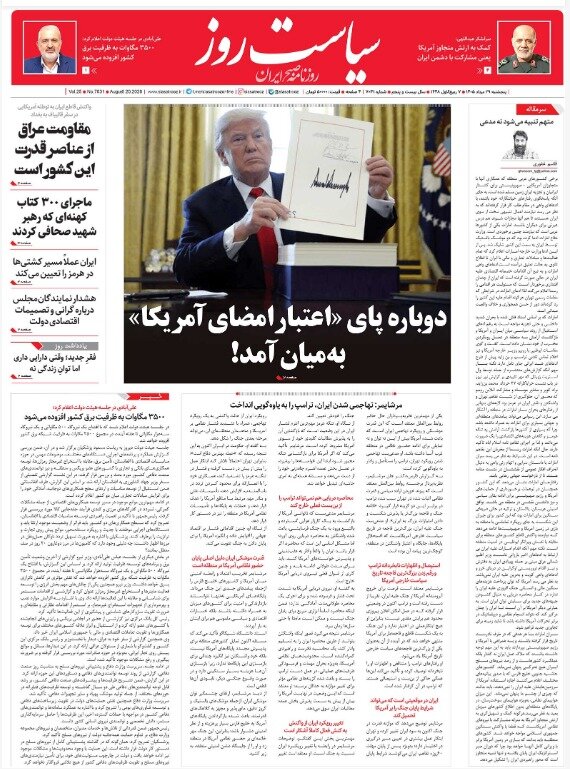
Siasat-e-Rooz devoted its editorial to the UAE’s regional behavior. According to the piece, Abu Dhabi’s actions show that the country still clings to the illusion that American and Israeli backing will guarantee its political survival and secure a role for it in the region.
The recent security pact among Saudi Arabia, Pakistan, and Turkey dealt a heavy blow to the UAE, yet instead of adopting a cooperative regional approach, it continues to play on the American and Israeli field; something that requires a firm response from regional countries to counter Abu Dhabi’s destructive role in regional security. The United States, unable to bear the high financial and human costs of waging war against Iran, is—alongside its naval blockade—seeking to open new fronts to wear down Iran’s capabilities.
Iran: A document founded on peace and friendship
The Iran newspaper, in an interview with Akbar Valizadeh, professor of regional studies at the University of Tehran, highlighted the importance of ratifying the Caspian Sea Convention for Iran. Valizadeh explained that the Caspian Sea is legally and geographically different from the Persian Gulf and the Strait of Hormuz, and the legal regimes of the two cannot be equated. However, recent developments carry a shared message for all regional states: the security of waterways and maritime navigation cannot be left solely to power balances; clear rules, cooperative mechanisms, and the responsibility of littoral states have become increasingly important. The Caspian Sea Convention gains significance precisely in this context. It defines the Caspian as a zone of peace, good neighborliness, friendship, and cooperation, and explicitly prohibits the presence of armed forces from non‑littoral states. It also emphasizes regional stability and the security of maritime navigation.
Sobh-e-No: Dimensions of an inspiring power
Sobh-e-No examined the dimensions of Ghalibaf’s trip to Iraq, arguing that if the visit is viewed merely through the lens of routine parliamentary meetings, official encounters, and neighborly relations, its true meaning will be missed. Today’s Baghdad is not just a diplomatic destination; it is a node in the geometry of regional power—one in which Iran must move from the phase of “accumulating power” to the more difficult phase of “transforming power”: turning deterrence into security, influence into benefit, geography into economy, and battlefield achievements into strategic dividends. Ghalibaf’s trip is described as one link in a larger chain: Iran’s regional policy shifting from the logic of merely preserving influence to producing benefit from influence. The visit also reflects multi‑layered diplomacy. Baghdad is not just the capital of a neighboring state; it is one of the testing grounds for Iran’s new regional rationality. The meaning of the trip should be sought not only in photos from Baghdad, but in this transition from “power for resistance to power for resistance and benefit.”
Etemad: Sanctions are America’s lever to force Iran to retreat
Etemad interviewed Seyyed Jalal Sadatian, a Middle East expert, about Washington’s return to “maximum pressure” and Tehran’s response to the US economic campaign. Sadatian argued that if the US claims the Strait of Hormuz is open, and ships pass freely, then why does it simultaneously threaten Iran with intensified economic pressure? This contradiction, he said, shows that Washington itself is affected by the situation in the strait and the restrictions on movement there. If energy reserves in Asia, Europe, or other consumers of Persian Gulf oil decline, the likelihood of a price surge and a global market crisis increases. In such a scenario, the US would face pressure from Arab states, European governments, and Asian economies to find a way to manage the crisis. Therefore, Trump’s escalatory threats are an attempt to impose greater pressure on Iran and push Tehran toward yielding to Washington’s demands.
Ettelaat: Tehran does not want the Kurdistan region to become a flashpoint
Ettelaat, in an interview with Ali Asghar Zargar, a foreign policy expert, emphasized the need to maintain calm with Iran’s neighbors. Zargar argued that Iran must demonstrate that its relations with the Kurdistan Region—despite existing sensitivities and disagreements—are not on a path toward tension. From the perspective of US reactions, it is crucial to show that Iran has no problem with Kurdistan or its regional government. This matters because any dispute between Iran and the Kurdistan Region could escalate from a local issue into a factor in broader regional dynamics. At a time when Iran and the US remain engaged in a multilayered confrontation, Tehran does not want friction with a neighbor to become a new source of external pressure. Trump has adopted new positions and is prioritizing economic sanctions. Iran must therefore manage the US file while also preventing new crises with its neighbors, since any fresh regional tension could further restrict Iran’s diplomatic maneuvering space.
Leave a Comment